My name is Marc de Kamps. This is my website. It contains blog posts and scientific topics that interest me. My first blog post is from 2022. Much has happened since then, so this site needs an update. My primary interest is how the human brain acquires its cognitive abilities from a large number of slowly responding, noisy, probably unreliable, but massively interconnected groups of cells. Even in the heyday of AI, this is still my primary motivation. And if this has applications in AI, then great. And it does. Consider first how a new version of our 2006 model, developed by Frank van der Velde can be interfaced with large language model (LLM) embeddings. Expect more on this site about that soon.
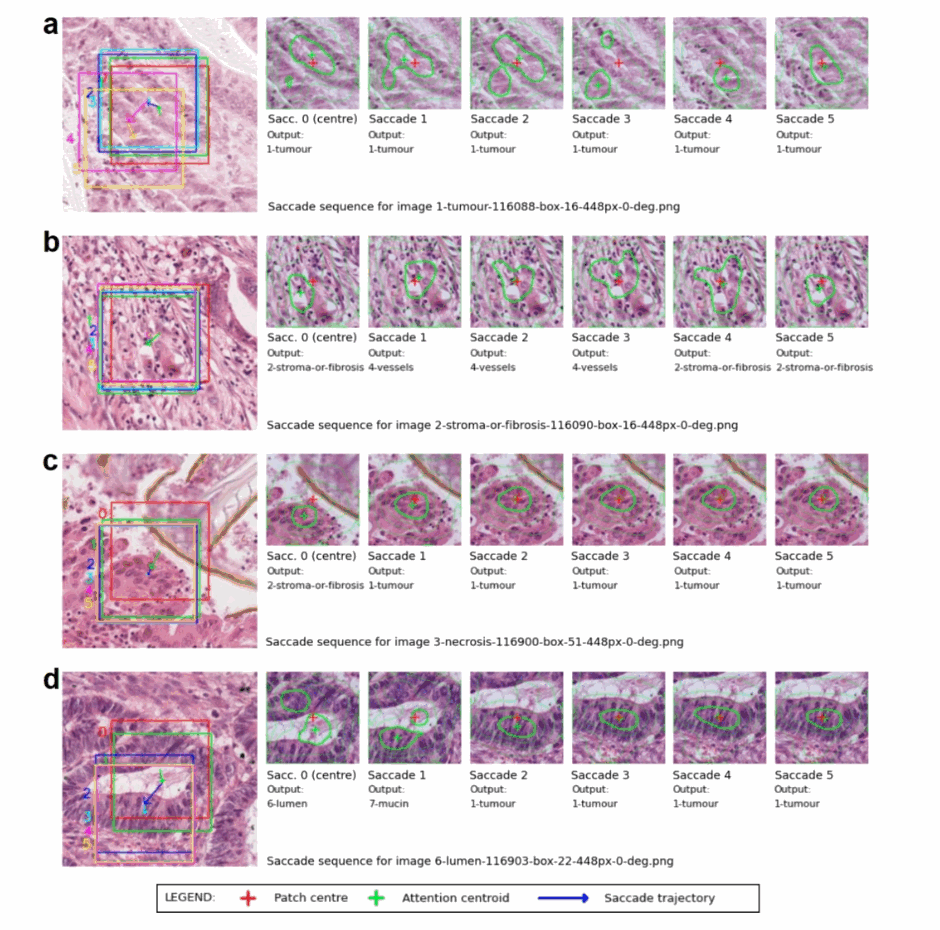
I’m very proud that a 2001 model for object-based attention inspired an image processing approach that improved a benchmark for tumour classification in digital histopathology.
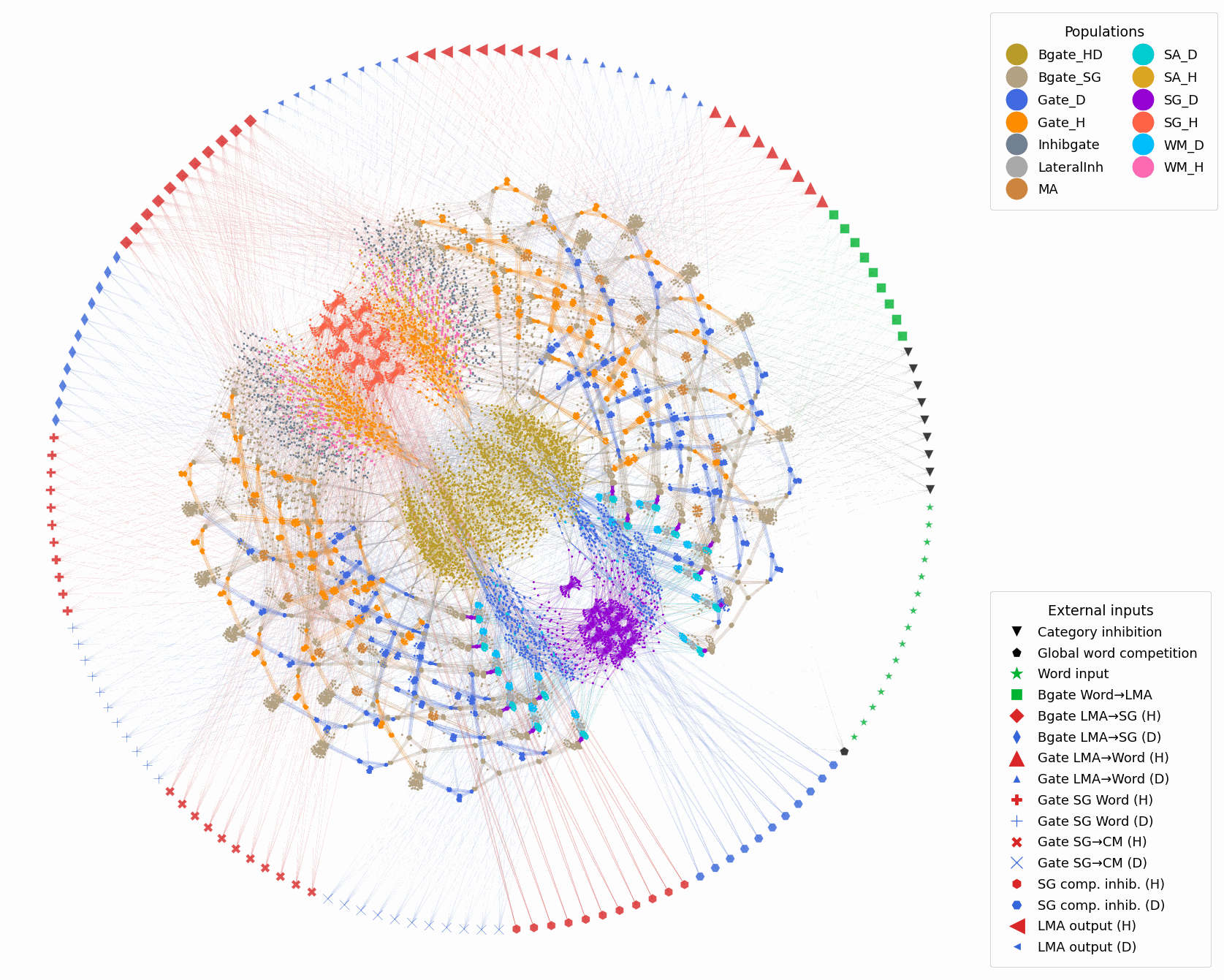
Humans are capable of extending their knowledge base without training on the entire internet, adding new titbits all the time without the need for retraining their whole brain, with the energy consumption of a light bulb. There is plenty of unsolved mystery here, AI revolution or not.
Industrial Collaboration
I have represented the University of Leeds in two Knowledge Transfer Partnerships, both with Vet-AI Ltd, a company that applies modern AI techniques (image processing, generative AI) in veterinary services. Our last KTP was rated outstanding by Innovate UK.
Articles
Longer pieces, written in the style of papers rather than blog posts.
Interests
Computational/Cognitive Neuroscience
After a PhD in physics I started a postdoc in a psychology department. As a consequence I’ve done research in this area. I was PI in the theory part of the Human Brain Project from 2015–2020. In 2006, Frank van der Velde and I published a proposal for a cognitive architecture: the neural blackboard architecture. Frank has made considerable progress of late on the linguistic side and in Leeds we have gained considerable expertise in simulating the model, where we have reworked Frank’s original simulator to create faster models.
I will also discuss the work of my former PhD student, Hugh Osborne, who has pushed population density methods where I thought they couldn’t go. Moreover, Hugh has modelled data from Samit Chakrabarty who investigates muscle activation of human subjects. Hugh’s model has interpreted the influence of proprioceptive feedback on so-called synergies: co-activation patterns of muscles that we all use to organise our movements, but which may differ from individual to individual.
Causal Inference
I was introduced to causal inference by Mark Gilthorpe. We both feel that machine learning and causal inference are skating close to each other.
Computer Graphics
I’ve taught computer graphics and got hooked on projective geometry and other aspects related to rendering. Computer graphics textbooks underplay the projective aspects somewhat, and that makes some maths topics harder than necessary, in my opinion. I think I can do better and will publish that here.
Machine Learning
I teach machine learning at the University of Leeds and am involved with neural network analysis of histopathology images with convolutional neural networks and variational autoencoders. The images come from a remarkable Leeds initiative, NPIC, the National Pathology Imaging Co-operative, run by Darren Treanor. He and Alex Wright co-supervised PhD students Andrew Broad and Jason Keighley together with me. They now are NPIC employees.
Serge Sharoff is a specialist in neural machine translation. I was co-supervisor of his PhD student Yuqian Dai who investigates the use of BERT, a transformer, in neural machine translation. For me this is an introduction to a novel world, artificial neural networks applied to machine translation.
Recently, I’ve become quite interested in variational inference and will write about it.
Mathematics
Always interesting. Latest exploration: Visual Differential Geometry and Forms by Tristan Needham. A book that has shocked me a number of times, for example with a proof of the Spectral Theorem (symmetric matrices have real eigenvalues and eigenvectors that are orthogonal) that is so simple it should be taught in every linear algebra course.
I will write blog posts about these topics, and at times organise them into more coherent pieces of text.
Posts
subscribe via RSS